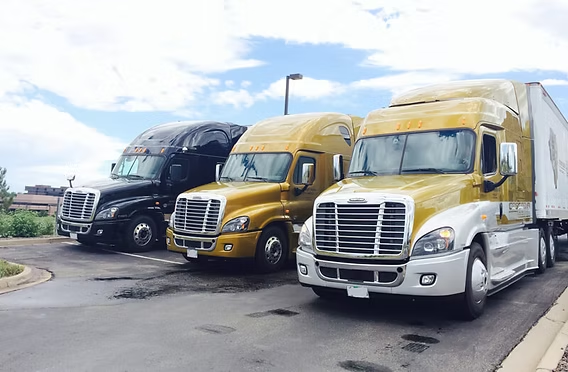
No matter if they work as freelancers or run their small business, the most significant decision that drivers often find is not routes or load boards but vehicle procurement. In the case when payment is less, renting a truck, truck purchase, truck financing, leasing a truck, or truck rental is an option that decides the success of the business in a dynamic market.
This article gives a brief between buy vs lease and lease vs rent only the stand of small capitalization. This is not a generic piece of advice for business owners going up, but rather, it deals with a realistic cost analysis, operational trade-offs, and financial constraints that are typical for small trucking companies and independent operators. It also covers the change of the risk, flexibility, and long-term planning from different acquisition approaches.
Fleet-ordering strategy is the top priority.
In small truck fleets, the truck is not merely an implement of work but the main asset for income generation. Wrong way of buying a truck can be different from cash flows being strong to the company going bankrupt.
The greatest limitations for small operators are:
- The wish to grow fast but there are no privileges regarding the financing options
- The truck cost variation is a sensitive factor
- Risk for unplanned repairs and high costs
- The freight low periods reduce the profit margins
All these make truck ownership, lease agreements, and rental options not only financial instruments but also tools for decision-making and emotional aspects of the decision-making process.
Choice one: A Truck Purchase — Total Control Total Responsibility
The Real Implications of Buying a Truck
A good number of the newly recruited drivers think that purchasing a truck is a matter of freedom. In real life, a truck operator will have to undertake operational and financial risks that go back to him. But in the case of small capitalization, the majority of the purchases will be used together with bank loans, dealer truck finance, or a combination of both.
Common purchasing cases are as follows:
- Buying an old truck for cash and keeping repair funds aside
- Financing an old truck through a dealer or bank
- Acquisition of an old truck without a capital buffer
The Financial Accountability of Possession
Truck ownership goes beyond just the obvious sticker price:
- Loan payments (if financed)
- Insurance premiums (usually high for owned units)
- Maintenance and unscheduled repairs
- Tires and wear components
- Revenue losses due to downtime
When the business can take risks without turning the cash flow negative, then only debt the business has is the ownership of the asset.
Pros and Cons of Truck Purchase
Pros
- You have full control of the asset
- No mileage or operational restrictions
- Lowest long-term cost if managed correctly
- Possible resale value
Cons
- High upfront capital requirement
- Full exposure to repair and downtime risk
- Financing approval challenges
- Cash flow instability in early stages
Best case scenario: buying is the thing for business owners with a great deal of capital, people who have the discipline to follow maintenance schedules, and a long-term view of how they are going to keep operating costs under control.
Option 2: Leasing a Truck — Predictability with Constraints
Leasing of Trucks
The leasing option may ease financial burdens to some extent but will create contractual obligations at the same time. Generally, the lease structure can be broken down into the following:
- Lease-purchase agreements
- Operating leases
- Carrier-tied lease programs
Each structure distributes risk differently and must be evaluated carefully, because lease agreement details sometimes matter more than the payment of it.
Cost Structure of Leasing
Leasing gives rise to the dependently pre-set costs:
- Weekly or monthly lease payments
- Inclusion of insurance in the deal (sometimes bundled)
- Maintenance responsibility (varies per agreement)
- Penalties for early termination or violations
Although leasing is beneficial for reducing the initial capital requirement, it gives you the cumulative cost in the end that is mostly higher than the cost of the real ownership of the truck, this is relatively more expensive when adding operating costs and contract limitations.
Pros and Cons of Leasing a Truck
Pros
- Less costly to set up initially
- Support for easier budgeting and planning
- Faster entry into operation
- Leaner requirements than traditional financing
Cons
- Fixed constraints
- Penalties as per contract
- Higher long-term cost
- Restrictions on usage or exit
Best fit: leasing suits operators testing independent operations, running a small business truck setup, or lacking capital for immediate ownership.Lease Op Vs Owner Op! What’s The Difference? @nohippietruckingandtransportat Reply
Option 3 Renting a Truck Flexibility at a Premium
The Essential Nature of Truck Rental
Renting a truck is not a long-term acquisition strategy. It is a supplant for seasonal logistics shifts, temporary replacing, or market testing. Rental agreements are usually on a daily or weekly basis, making it more valuable in terms of speed and flexibility, not in terms of profit-making.
Cost Structure of Renting
The expenses that you acquire while renting trucks will typically include:
- The high fixed daily or weekly rate that is included in the rental contract
- Mileage charges
- Insurance add-ons
- Minimal maintenance responsibility
Renting can turn in fixed costs into variable expenses which is at a cost of being the most costly option per mile.
The Pros and Cons of Renting a Truck
Pros
- No capital investment
- Immediate availability
- Minimal long-term liability
- Ideal for short-term needs
Cons
- The highest operating cost
- Not a viable long run
- Limited customization
Best case: renting is only considered as a temporary solution in extreme cases when the cash is very limited and rental options are used as a bridge not as a plan.
Cost Comparison Table: Buy vs Lease vs Rent
| Factor | Buying a Truck | Leasing a Truck | Renting a Truck |
| Upfront capital | High | Low | Very low |
| Expense predictability | Medium | High | Low |
| Maintenance risk | Full | Partial | Minimal |
| Flexibility | High | Medium | High |
| Long-term cost | Lowest (if managed) | Medium–High | Highest |
| Best for | Long-term operators | Early-stage businesses | Short-term needs |
Small Capitalization Scenarios Explained
$15,000–$25,000 Capital
Buying: Possible with older equipment, high risk
Leasing: Often the safest entry
Renting: Short-term bridge only
Strategy: lease first, stabilize cash flow, reassess ownership later using more stable acquisition methods.
$30,000–$50,000 Capital
Buying: Viable with conservative assumptions
Leasing: Acceptable but less efficient
Renting: Not recommended
Strategy: buy carefully with strong cost control and attention to operating costs.
Under $10,000 Capital
Buying: Not viable
Leasing: High risk
Renting: Survival-only option
Strategy: delay entry or operate under a carrier until capital improves.
Operating Costs Matter More Than Acquisition Price
Many a small business owner gives more stress on the cost of acquiring instead of focusing on the actual operating. This is a key mistake.
The issues that matter most are:
- Cost per mile
- Downtime exposure
- Maintenance control
- Insurance requirements
- Cash flow stability
A less costly truck that experiences longer downtimes is always more expensive than a truck that is reliable albeit costs more to purchase upfront, the reason behind this is that operational costs play a much bigger role than the purchasing decision when it comes to the ability to generate a profit.
Financial Strategy: Matching Risk to Capital
Vehicle acquisition for small-cap trucking is not about choosing equipment, but about structuring exposure to risk, cash flow pressure, and long-term survivability.
A financial program that works is one which aligns risk with capitalization:
- Low capital → decrease fixed obligations and avoid long, restrictive commitments
- Medium capital → maintain predictability and control
- Higher capital → total cost of ownership is optimal and reduces the risk of downtime
In other words, buy vs lease is not just about repayment comparison but a risk structure decision. Additionally, lease vs rent is sometimes a question of time horizon: short-term access versus long-term stability.
In the Final Considerations: There is No Universal Best Choice
The answer cannot be the same in all situations regarding whether to buy-lease or lease-rent. The right acquisition mode depends on:
- The amount of capital available
- The level of risk acceptance
- The period of business activity
- The discipline of operations
The reality is, when it comes to small-cap trucking businesses, ambition has to take a backseat to everything else. The acquisition strategy that ensures that the operation draws on the next month is the best, not the one that looks cool on paper.
In the trucking sector, stability will, as always, prevail over rashness.
Small trucking companies should target the acquisition of the vehicles to the first step at risk control rather than ownership ambition. The road that drives one to least fixed obligations tied to available capital is the safest way. Leasing or short-term rental usually provides more safety than purchasing, even if cash reserves are scarce. The reason is that with the risk it seems to have been initially lower but it will not eventually turn out that way. Also, the risk in terms of deployment of cash resources will be higher.
A commercial truck should never be evaluated just on its sticker price. Downtime exposure, maintenance predictability, and insurance needs, along with cost per mile, are the actual figures that define its financial impact. A lower-priced truck, which often breaks down, usually generates bigger losses than a more expensive but reliable unit.
FAQ
Why a truck is seen as a business vehicle instead of a personal asset?
A truck is mainly a truck is a business, not a personal vehicle, in the case of a small fleet. It is responsible for the cash flow and at the same time it brings in fixed costs. Having it as a business asset allows decisions on maintenance, replacement, and exit strategies to be made more objectively, thanks to the market situation.
What are the real merits and demerits of purchasing and leasing a truck?
The benefits and drawbacks come down to the degree of capitalization and the time frame you are considering. The purchase gives you control and is the most economical way in the long run, however, it leaves the user with the full burden of repair and downtime. While Leasing increases the predictability and shortens the entry, it generally raises the overall cost of ownership and limits flexibility. The choice of the best one will depend on the current financial strength rather than long-term visions.
How does the financial strategy decide between buying, leasing, or rental?
A well-thought-out financial strategy prioritizes equipment choices according to capital and risk levels. Low capital goes hand in hand with more flexibility, hence the need for short-term agreements, whereas a more substantial capital base allows the company to own the equipment and thus save costs over time. The wrong decision can be so severe that what used to be a sustainable operation can be transformed into a cash flow crisis, even when freight demands strong.