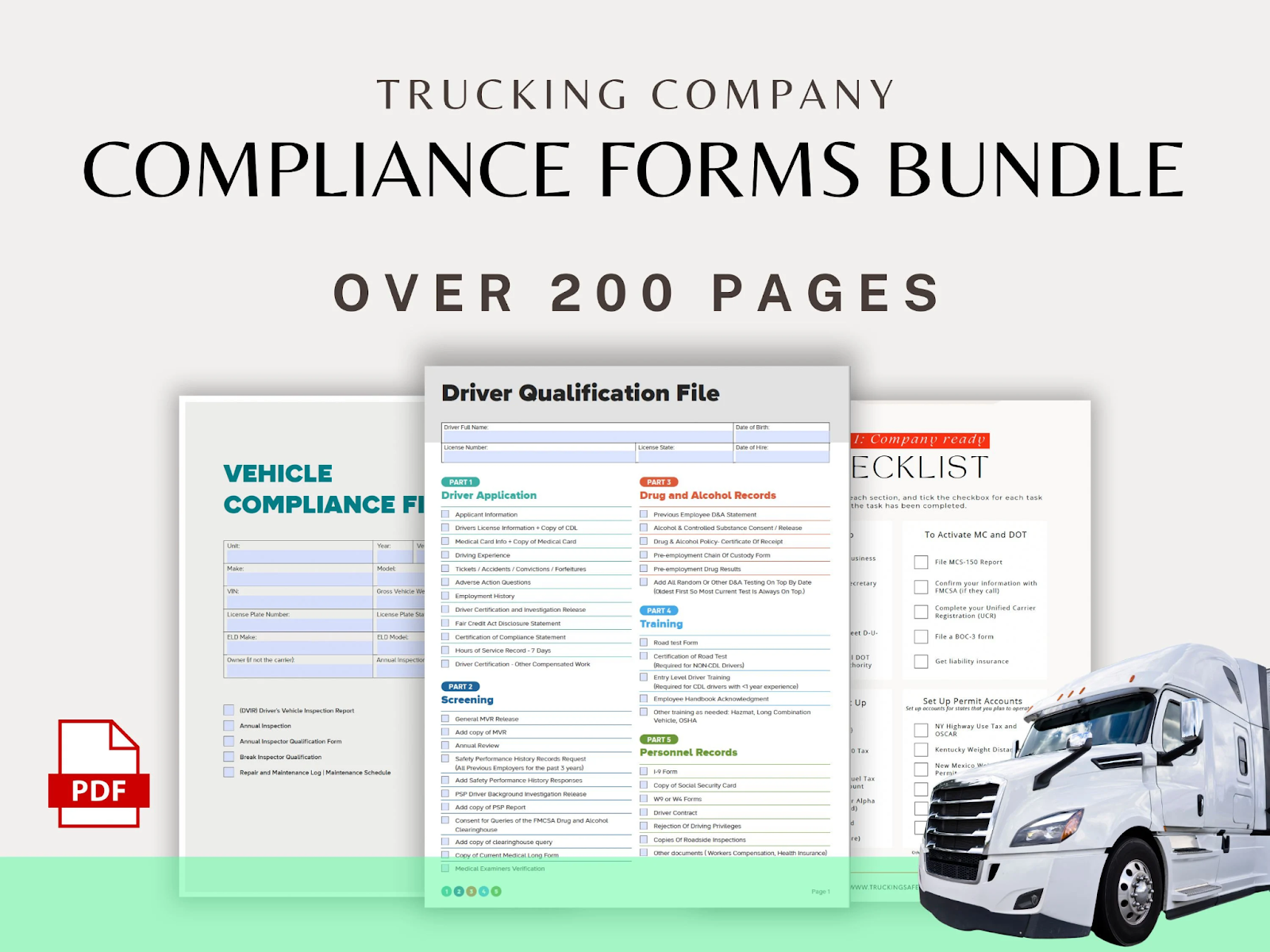
Running a small trucking operation is not really complicated but problem arises mostly outside the cab in the paperwork, compliance, and financial obligations that affect the profitability silently. Trucking business taxes, insurance coverage, and registration requirements are not side topics. They are the factors that determine if a business will run regularly or if it will always react to penalties, audits, and cash flow gaps.
For owner-operators and small fleets, these areas often feel overwhelming because they are intertwined. Tax filings affect insurance costs, registration status impacts operating authority, and compliance errors ripple through the entire operation. This article features real-world truck driving operations to answer questions that trucking businesses have when they navigate taxes, insurance, and registration which is the aim, including the most common frequent questions trucking operators ask in the first years.
Trucking Business Taxes: What Small Operators Actually Need to Manage
Having taxes in a trucking business means they are part of the decisions made by the owner of the business and are not a once-a-year concern.
How owner operators are taxed | Owner Operator Taxes | Trucking Business 101
Owner operator taxes are heavily influenced by the distance they drive, the amount of fuel they purchase, and the timing of passenger cars’ revenue. Owner-operator taxes could include federal income taxes, self-employment taxes, state dues, special sector-specific returns, and business licenses.
Q4 Pay Taxes is considered one of the most confusing topics in tax payment. Company drivers automatically come with withholding, but independent truckers do not. The result of it failing to estimate and pay taxes quarterly is that there will be penalties that come out long after the money is already used. So, many profitable months can finish turning into year shocks at the end of the year.
Another issue is IFTA tax filing. Fuel taxes should be based on the mileage for each jurisdiction, and not the place where the fuel is purchased. Sparse mileage tracking or late filings can cause sanctions and penalties, resulting in audits. Likewise, the federal heavy vehicle use tax (HVUT) is applicable to most vehicles over 55000 pounds and needs to be filed every year before the registration is valid. According to IRS requirements, Form 2290 (HVUT) must be filed annually for vehicles over 55,000 pounds to keep registration valid. https://en.wikipedia.org/wiki/Form_2290
Tax planning is also influenced by business structure tax implications. A sole proprietorship, LLC, or S-corp can change how income is taxed and how deductions are handled. Structure alone doesn’t reduce taxes, but it changes the liability you have and the complexity of reporting you get.
On top of the obvious, many truck drivers forget to claim truck driver tax deductions that they legitimately have, per diem, depreciation, maintenance, and communication tools. These truck driver tax deductions will lower the taxable income but they will only be there if the records are clean and defensible.
Taxes are not only compliance – they are also part of cost control.
Insurance for Small Trucking Businesses: Coverage vs. Survival
Insurance is usually considered the second-highest cost element for trucking operations after fuel. The right small trucking business insurance is found by connecting the correct coverage with the real risks rather than just the price, and choosing the best commercial truck insurance is not about being cheap but about being operationally safe.
Most small operations start with commercial auto liability, which is mandatory for operation authority. Nevertheless, liability coverage just does not cover the truck, the cargo, or income during downtime. It is where the confusion starts.
Real-life semi truck insurance costs are mainly dictated by driving records, load characteristics, range of operation, and compliance records. New authorities usually pay higher premiums, and a bad claims history will increase the costs even faster.
Other than liability, many operators need:
- Cargo insurance for truckers, which is required mostly by shippers
- Physical damage coverage for the truck
- Non-trucking liability (bobtail) in certain lease agreements
The risk of underinsuring is short-term savings but leads to almost catastrophic losses. On the other hand, overinsuring is just cash flow drain without any true benefit. The right line is important.
An additional is DOT compliance. Basic air quality, safety, and lapsed coverage issues lead to hikes in premiums or even cap on coverage. Insurance firms are in a way compliance monitors and closely track their partner’s behavior.
For little fleets, insurance should always be revised every year and not merely renewed and forgotten. Growth, changes in equipment, or freight shifts call for policy adjustments. Spending on insurance is not simply safeguarding against risk, it is a matter of survival.
Registration and Operating Authority: Where Most Compliance Errors Begin
Registration errors often cause the end of otherwise profitable operations. Commercial truck registration is not merely a one-sage process but a chain of evolving requirements that have to stay synchronized.
The main part is the vehicle title and registration which has to correctly state the owner, weight class, and jurisdiction. The enforcement of weight misdescription issues arises despite the load being legal.
Small operators also confront small fleet registration requirements like:
- IRP (International Registration Plan)
- UCR filing (Unified Carrier Registration)
- Permits at the state-level based on the operation
Missing or late UCR filing which is a common violation triggering roadside penalties is another layer. Similarly, IRP discrepancies often result in visible errors during the police inspections than during audits.
The trucking operating authority is another element of concern. The authority status should align with the activities that are actually taking place. Locating the freight, running as a non-resident, or intrastate vs. interstate move changes the process for lenders.
Maintenance of registration is importantly connected to the ELD mandate compliance. Holding non-compliant ELD records can lead to increased inspections and the related results of the insurance and authority status.
The basic mistake most small operators make is regarding registration as a one-time setup. In fact, this is an ongoing compliance system and has to be kept running even when the company changes.
The Coordination of Taxes, Insurance, and Registration in Daily Operations
These three functions are not separate from each other; their interrelationships are the main reason for that. A change in one often has an impact on the others.
As an illustration:
An expansion of the operating radius will hit premiums and IRP reporting.
Adding a truck will mean HVUT, refiling registration, and insurance.
Improper tax records translate to elevated risk and insurance.
This inter-relation is the root cause of many trucking businesses failing without any apparent reasons. Trucking business expenses grow painfully unchecked until the compliance gaps grow. Below is a clearer picture of the cash flow operational area.
Trucking compliance checklist for owner-operators
Compliance Impact Overview
| Area | Common Mistake | Immediate Effect | Long-Term Risk |
| Taxes | Missed quarterly payments | Penalties | Cash flow instability |
| Insurance | Minimal coverage | Lower premiums | Catastrophic loss |
| Registration | Late filings | Fines | Authority suspension |
| DOT compliance | Poor records | Inspections | Higher insurance cost |
| ELD compliance | Incomplete logs | Citations | Audit escalation |
The trucking business is very unforgiving towards disorganized management. Consolidation is not an option.
Small Trucking Businesses: Answers to Frequently Asked Questions
Small operators, especially in the early years, usually ask similar questions — these are the kind of frequent questions trucking operators return to again and again.
Do I need to make quarterly tax payments even if my business is facing losses?
Absolutely. Missing these taxes changes your tax liability to an amount that many businesses can not handle at one point.
Is the cheapest insurance a good idea?
Definitely if the coverage fits the risk profile. Coverage and risk definitely do not always match.
What happens if the registration is not valid for only a few days?
There will be inspections, fines, and even potential authority disruptions. Even a few days could mean weeks in waiting time.
Is it possible to manage compliance on my own?
Yes, but only if you have discipline and keep good records. Outsourcing costs less than elected chaos.
The frequently asked questions of a trucking operator are the ones that stress the truth: compliance is not just knowledge, but it is about systems.
Regulations Are Not Optional — They Are Operational Reality
The trucking industry is heavily regulated and is not getting any easy. The authorities are enforcing the laws through the use of data that gives them accurate information on insurance, taxes, and regulatory compliance. These trucking industry regulations affect the way operators register, insure, and report their business activity year-round.
DOT compliance, IFTA tax filing, ELD mandate compliance, and insurance reporting work together as a system of oversight. When one area is weak, the whole operation is at risk.
The small freight transporter’s objective is to be as predictable as possible. Fixed taxes. No fluctuation in insurance costs. A registration that is always in good standing.
The viability of trucking as a safe business lies in the fact that it is not a training ground for emergency management.
Final Verdict: Compliance Can Be a Source of Profit
The perception of taxes, insurance, and registration as merely shackles is simple yet flawed. They are instead the right instruments that help you move forward. With deliberate control, they easily become cash flow stabilizers, de-stressers, and profit protectors.
The death of a small trucking business due to paperwork is not real. It is the case of turning paperwork into financial emergencies by ignoring them.
Operators who carry out compliance continuously and try to integrate it into their day-to-day operations create businesses that will last longer than a few good cycles of freight.
In trucking, compliance is not just about avoiding punishment. It is about controlling every aspect of your business.
In the end, the timely truck which is driven to generate profit is based not on the ability to act on time after problems arise, but rather on the foresight to prevent them from appearing in the first place. The operation pilots at the tax planning level, the insurance bearings are set according to the actual risk taken, and the continuous good standing status of the vehicle registration proves that it actually stops losing money through tiny damnable holes. Compliance thus turns from being a tribulation to becoming a management tool – the one that safeguards the margins, minimizes the uncertainty and frees out the owner-operators to handle freight and make decisions as opposed to a permanent struggle with administrative mistakes.