
For truckers, it is definitely not a mistake to implement profit. It is simply that it is a long and usually unnoticed decrement of profit resulting from such causes as the lack of plan fuel stops, rescheduled service, non-buddified freight, and a low cash flow. The weekly checklist is the key to freedom, but it also, first of all, provides you with the clarity of your operations. The disorganized week of work is turned into a process of planning in a logical sequence — a controlled planning process.
This template is indeed useful. It clarifies the role truck owners, drivers, and dispatchers play in their learning about load planning, cash flow management, and operational optimization. The primary aim is straightforward: to safeguard the income, to cut down on unforeseen events, and to make the right choice from the very beginning of the wheels starting to roll.
Weekly Planning Checklist Overview
| Planning Area | What to Review Weekly | Why It Matters |
| Fuel | Fuel stops, price zones, route alignment | Prevents margin loss from reactive fueling |
| Vehicle Service | Maintenance schedule, known issues | Avoids unplanned downtime and breakdowns |
| Cash Flow | Expected settlements, fixed expenses | Prevents liquidity gaps and forced decisions |
| Loads | Load sequence, deadhead, RPM | Improves profitability, not just utilization |
| Driver Hours | Available HOS, resets | Protects compliance and load execution |
| Compliance | DOT-sensitive items, inspections | Reduces violations and operational risk |
Weekly Fuel Planning: Cost Control Before The First Mile
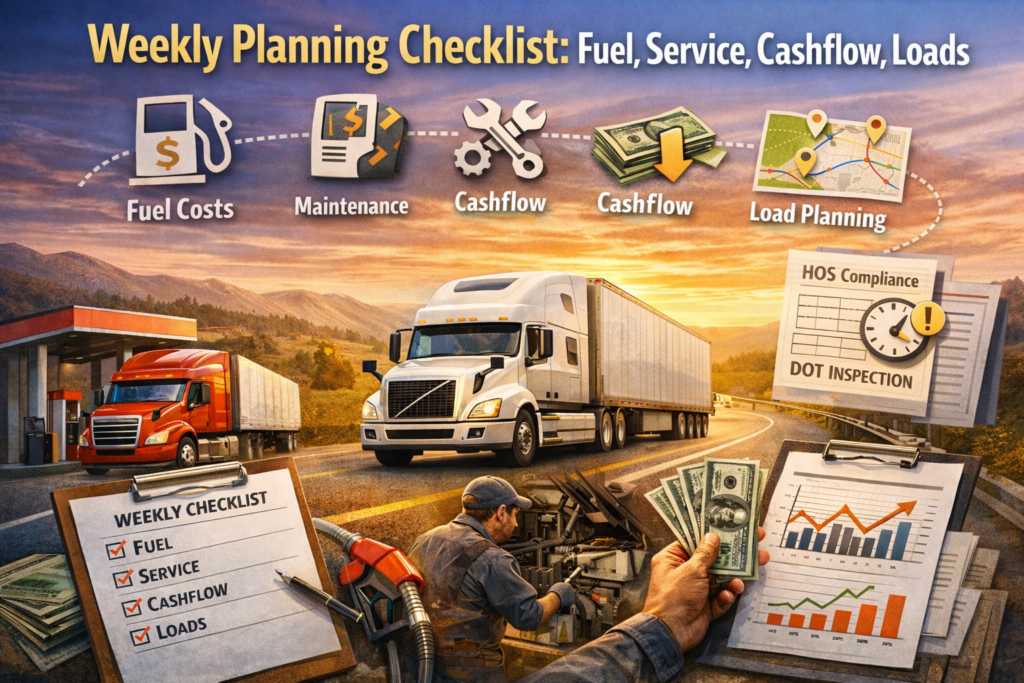
Truck fuel is not just a variable cost — inadequate planning is one of the quickest routes to profitability erosion.. Your weekly fuel planning should not begin after fuel stops are finalized, but rather before those newly planned stops interfere with load booking.
Key proposals for early week questions are:
- Where will fuel purchases be made based on route planning, not on a convenience basis?
- How is the fuel pricing linked with the planned freight loads and miles?
- Are there any fueling points that can declutter the idling or deadheading?
A proper fuel strategy takes into account:
- Expected miles per load
- Effect of weather and topography on consumption
- Driver hours and idle risk
- Tank strategy (partial vs full fills)
Fuel planning and logistics are two sides of the same coin. Moreover, a lower load cost burdened with a poor fueling choice often is going to be, in fact, it will always be, more expensive than a slightly lower-paying load that has better access to fuel. This is primarily a logistics strategy decision, not a question of convenience. Weekly transparency lets dispatch and drivers to be on the same page to schedule fuel stops with load sequencing rather than acting on the road.
When fuel planning is done weekly, instead of daily, it becomes no longer an abstract game but starts saving profits.
Vehicle Service & Maintenance: Preventing Precious Interruptions
Lack of maintenance planning is not a good idea as it is in fact a transfer of problems one week later. A weekly assessment of vehicle service and maintenance schedules is consequential for the keep on going of your operations.
Every week should see a shortened service check-up:
- Preventive maintenance according to mileage: list of things
- Potential load-up issues
- Tires, brakes, fluids, and warning indicators
- Service windows and dispatch commitments synchronization
Maintenance planning should be coordinated with driver hours and compliance rules. An idle truck parked in the maintenance yard without a plan can disrupt route booking, result in load delays, and reduce income.
Intelligent operators consider maintenance and inventory management as complements; the truck is the primary asset, and its availability determines the capacity for income. Forward-looking maintenance scheduling has the following outcomes:
- Better load selection
- Fewer emergency repairs
- Predictable downtime as opposed to forced breakdowns
Weekly problem-solving does not obligate you to solve all problems. You just need to be in a position to know about upcoming issues and make a decision about the best time for addressing them.
Cash Flow Management: Seeing the Week Before It Happens
Revenue without visibility is no control at all. In fact, the weekly monitoring of cash flow management is the measure that separates stable operations from the one filled with stress.
Each week should heed to the following inquests:
- What sum of money is expected to be remitted in the course of the week?
- What are the expenses that need to be met without consideration of the distance?
- How do fuel, service, insurance, and factoring affect net cash?
Here the income expense tracking comes into play. Weekly planning presents you with an opportunity to:
- Match loads to the cash flow needs for a short term
- Avoid the acceptance of freight that generates negative timing conflicts
- Decide whether to go for distinguishing fast-pay loads or higher-margin extended settlements
Regular visibility of the weekly budget benefits the intentional decisions over the spontaneous ones.
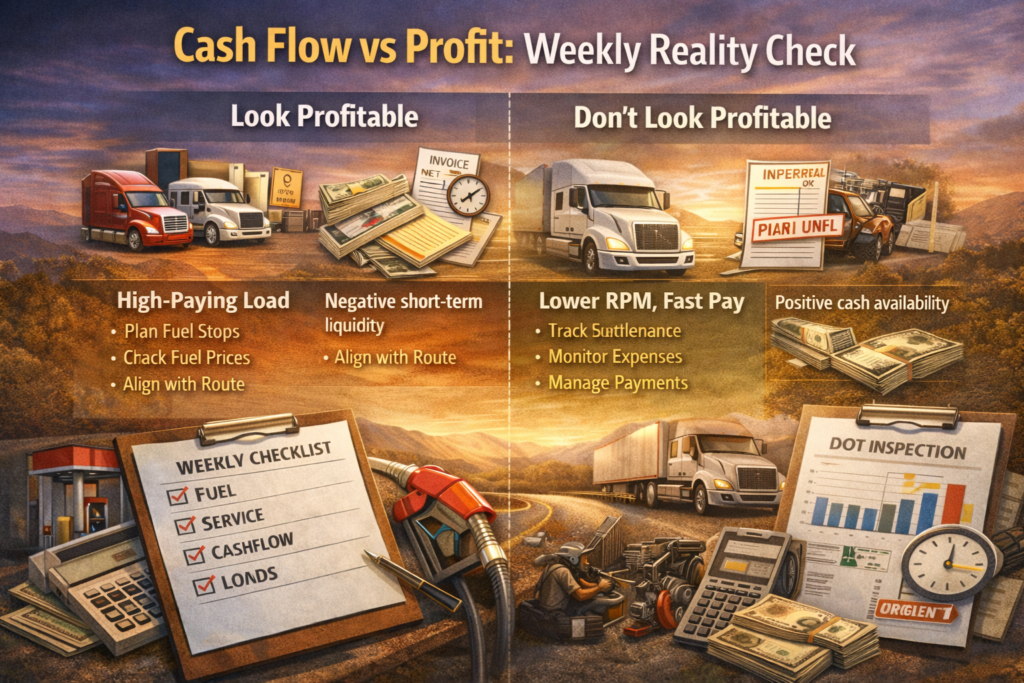
Cash flow should never be confused with profit. A week can appear to be profitable based on paper while it creates liquidity strain on the other. Weekly visibility of the factors renders unwanted decisions from being made due to panic instead of strategizing.
Cash Flow vs Profit: Weekly Reality Check
| Scenario | Looks Profitable | Cash Flow Impact |
| High-paying load, slow pay | Yes | Negative short-term liquidity |
| Lower RPM, fast pay | No | Positive cash availability |
| Deferred maintenance | Yes (temporarily) | High future cost risk |
| Emergency repair | No | Immediate cash drain |
| Full utilization week | Yes | Can still create cash pressure |
This step does have a direct effect on profitability because operators who are not blinded by cash issues use intended load choices rather than reactive ones. Revenue without visibility is no control at all. In fact, the weekly monitoring of cash flow management is the measure that separates stable operations from the one filled with stress.According to industry best practices, efficient route planning and load optimization reduce fuel expenses and improve revenue per mile, while regular maintenance prevents costly downtime and supports better cash flow management.
Load Optimization: Sequencing Freight, Not Just Accepting It
Load optimization is what makes a difference between being busy and profitable — the true starting point of load optimization is dispatch. The weekly planning approach helps you change your mindset from checking “what loads are available” to deciding “what loads fit the planning”.
An efficient weekly logistics load review needs to include:
- Interconnected loads geographically
- Deadhead impact between freight loads
- Driver hour and service window compatibilities
- Revenue per mile after fuel and time costs
This is where the coordination between drivers and dispatch becomes essential. Weekly objectives comprise:
- Preferred lanes
- Target revenue
- Acceptable downtimes
- Compliance limits
Weekly routing without a load plan coincides with fragmented routing and wasted hours. The shift of attention to the road map becomes intentional and logistics cease to be reactive with a weekly rhythm.
Compliance, Driver Hours, and Operational Efficiency
Overlooking compliance at the same time is a guaranteed way of losing income. A weekly plan should incorporate a quick compliance review:
- Remaining driver hours
- Reset planning
- Load timing vs HOS limits
- DOT-sensitive service or inspection needs
Compliance is more than just paperwork — it is also a part of operational efficiency. When hours are properly planned, loads are better sequenced, service is accurate, other dispatch decisions are improved.
Weekly planning also makes weekly goals clearer:
- Target miles
- Target revenue
- Acceptable idle time
- Planned service or rest days
Crystal clear goals lower the last-minute rush and enhance the task done-outcome in general.
Weekly Review and Adjustment: The Final Fill
Weekly planning does not end once the paper of planning is done. The writing of the plan is only a starting point. One of the critical and often-neglected steps is the brief weekly review that closes the loop between the intention and the actual reality. In this phase, operational efficiency can either be reinforced or gradually weakened.
By the end of the week, the operators should quickly assess the following:
- Which assumptions about fuel were correct? Which ones were wrong?
- Was the timing of the service identical to that of the actual load execution?
- How did the cash flow look comparatively with the expected cash flow?
- Which of the loads were efficient and which ones were only paper assets?
This review is neither about blaming nor is it about the correction of mistakes in hindsight. This is a review of the patterns. Over time, by watching these tiny weekly behaviors we can create a clear picture of how fuel choices, maintenance times, routing decisions, and cash flow affect the real situations.
The real worth of this step is in adjusting. Routes that seemed efficient, however, caused delays will be marked. Fuel strategies that in theory should have saved money but in practice added idle time can be modified. Loads that depleted driver hours or compliance can be deferred until next week.
In the absence of a review, weekly planning tends to become a habitual tedium. Whereas, with a review, the planning procedure advances. Conclusions are more accurate, predictions more realistic, and unexpected happenings are fewer.
A little weekly review makes planning a moving operational system instead of a static checklist which improves quietly, week after week.
Why a Weekly Checklist Actually Creates Freedom
A lot of drivers have a tendency to intertwine planning with restriction; however, in fact, it is the other way around. A weekly checklist, in fact, designed this way, does not lay the groundwork for flexibility. It prevents it. By planning a week, fuel, service, and cash flow decisions as well as freight are under control.
This habitual procedure does not diminish your flexibility; on the contrary, it saves it. When the week is planned, the things on the road will be easy, fast, and cheap.
In trucking, freedom is not a full absence of structure. It is the ability to choose knowledgeably, without being forced by unexpected expenses, missed service, or cash shortages. The making of a freedom checklist once a week is the mode through which this freedom is attained — quietly, steadily, and beneficially.
Frequently Asked Questions
How detailed should a weekly planning checklist be?
It should be sufficiently detailed to get rid of any potential overlaps early. The aim is visibility, not micromanagement.
Is weekly planning useful for solo drivers?
Definitely. For solo drivers, it is the most as every mistake results in direct loss of income and downtime.
How long does weekly planning usually take?
Most experienced operators stretch 30–45 minutes. That time is often spent saving hours of stress and thousands in reactive costs.
Does planning reduce flexibility on the road?
No. It increases flexibility by eliminating uncertainty and last-minute pressure.
What if the plan breaks midweek?
That’s normal. A weekly plan sets a baseline, not a prediction. It helps you to adapt intelligently rather than react stupidly.